How to optimize heating profiles for PET preforms? The Ultimate Thermodynamic Engineering Guide for ISBM
Within the highly sophisticated ecosystem of global plastic packaging manufacturing, the structural integrity, optical transparency, and dimensional perfection of a Polyethylene Terephthalate container rely entirely upon one profoundly complex thermodynamic sequence: PET preform heating profile optimization. For corporate production directors, chief packaging engineers, and quality assurance specialists, mastering the delicate art of thermal manipulation is the absolute prerequisite for achieving industrial dominance. As the premier, globally recognized Brazilian Injection Stretch Blow Molding manufacturer, the engineering consortium at Sempre-Potenza engages in a relentless daily battle against the physical boundaries of polymer thermodynamics. In this exhaustively detailed engineering treatise, we will completely deconstruct the methodologies behind optimizing heating profiles for PET preforms, providing your facility with a comprehensive blueprint for achieving zero-defect, ultra-high-velocity manufacturing.
Optimizing the thermal profile of a preform is vastly more complicated than simply increasing or decreasing numerical values on a machine control interface. It is a highly intricate symphony involving polymer rheology, infrared radiation penetration dynamics, material crystallization kinetics, and mechanical stretching velocities. Even a microscopic thermal imbalance will instantly precipitate catastrophic manufacturing defects, including severe stress whitening, thermal haze crystallization, uncontrollable wall thickness deviations, or devastating structural ruptures. Throughout this authoritative guide, we will explore the foundational physics of latent heat management in single-stage ISBM, dissect the advanced strategies for constructing flawless axial and radial temperature distributions, and demonstrate how deploying the elite Ever-Power machinery portfolio grants your facility the ultimate power to transcend conventional thermodynamic limitations.
Phase One: The Foundational Polymer Physics and the Glass Transition Window
To truly master the optimization of heating profiles, one must first possess a profound, molecular-level understanding of how Polyethylene Terephthalate behaves across varying thermal spectrums. PET is a semi-crystalline thermoplastic resin. During the initial injection phase, the molten polymer is forced under immense pressure into an aggressively chilled mold cavity, where it undergoes extremely rapid quenching. This violent, instantaneous cooling freezes the polymer molecular chains in a chaotic, highly entangled state, resulting in a perfectly transparent, amorphous preform.
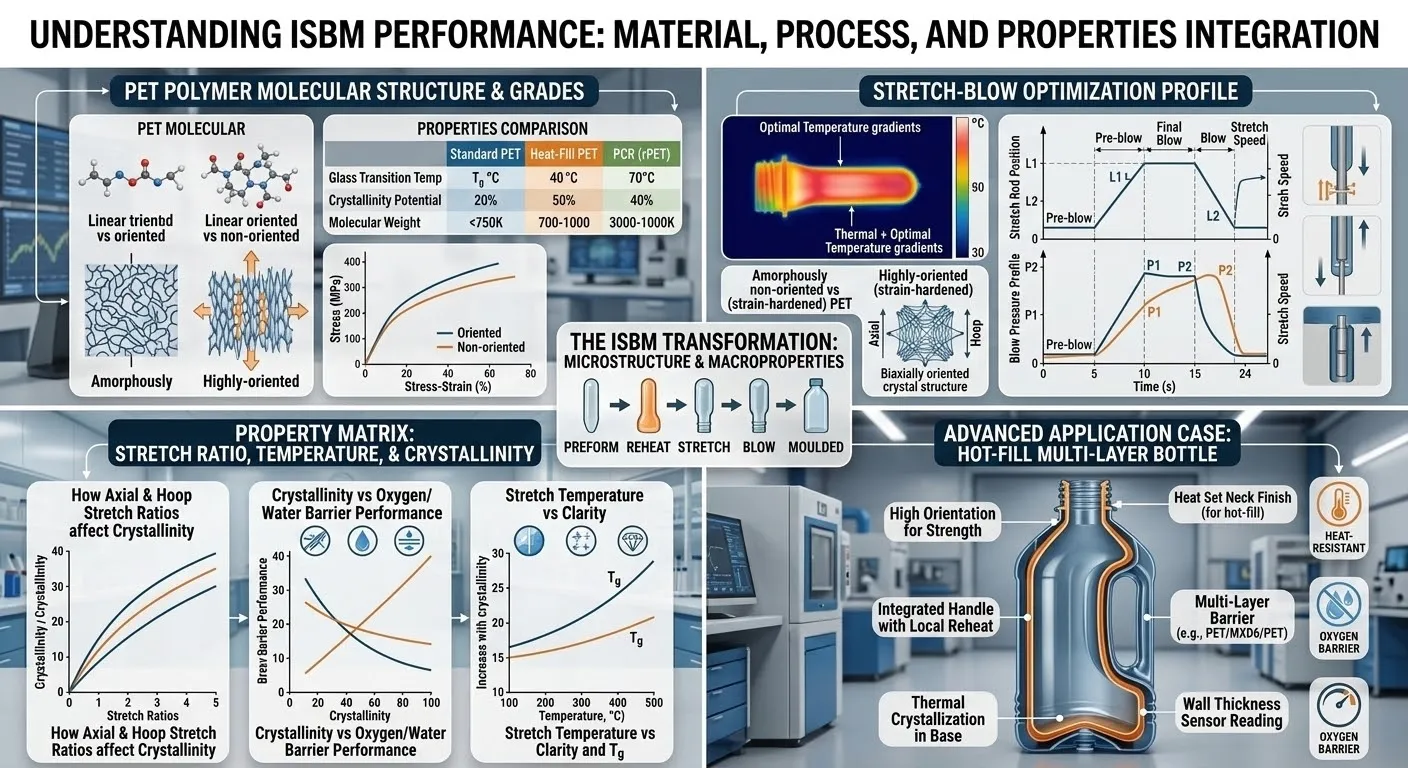
To successfully stretch this rigid, amorphous preform into a highly resilient container, the molecular chains must be thermally awakened. This introduces the most critical concept in ISBM engineering: the Glass Transition Temperature. For standard packaging-grade PET, this optimal processing window exists in an incredibly narrow band, typically between seventy-five and eighty-five degrees Celsius. Within this highly specific thermal environment, the PET transitions from a rigid, glass-like state into a highly elastic, rubbery condition. It is only within this exact thermodynamic window that the mechanical stretch rods and high-pressure blow air can force the molecules to align flawlessly in both parallel and perpendicular directions—a phenomenon scientifically defined as strain-induced crystallization or biaxial orientation. This perfect alignment yields a container with indestructible drop-impact resistance and brilliant, glass-like optical clarity.
If the heating profile is configured too cold, the core of the preform fails to reach the glass transition point. When the machine attempts to forcibly stretch this cold plastic, the molecular matrix physically tears on a microscopic level, creating a rough, cloudy defect known as pearlescence or stress whitening. Conversely, if the heating profile applies excessive thermal energy, the polymer chains gain too much mobility and spontaneously fold into massive spherulite crystal structures. This generates irreversible thermal haze, turning the bottle milky white and rendering it incredibly brittle. Therefore, the ultimate objective of heating profile optimization is targeting this incredibly narrow thermal corridor with absolute, unyielding precision.
Phase Two: The Supreme Advantage of Single-Stage ISBM Latent Heat Management
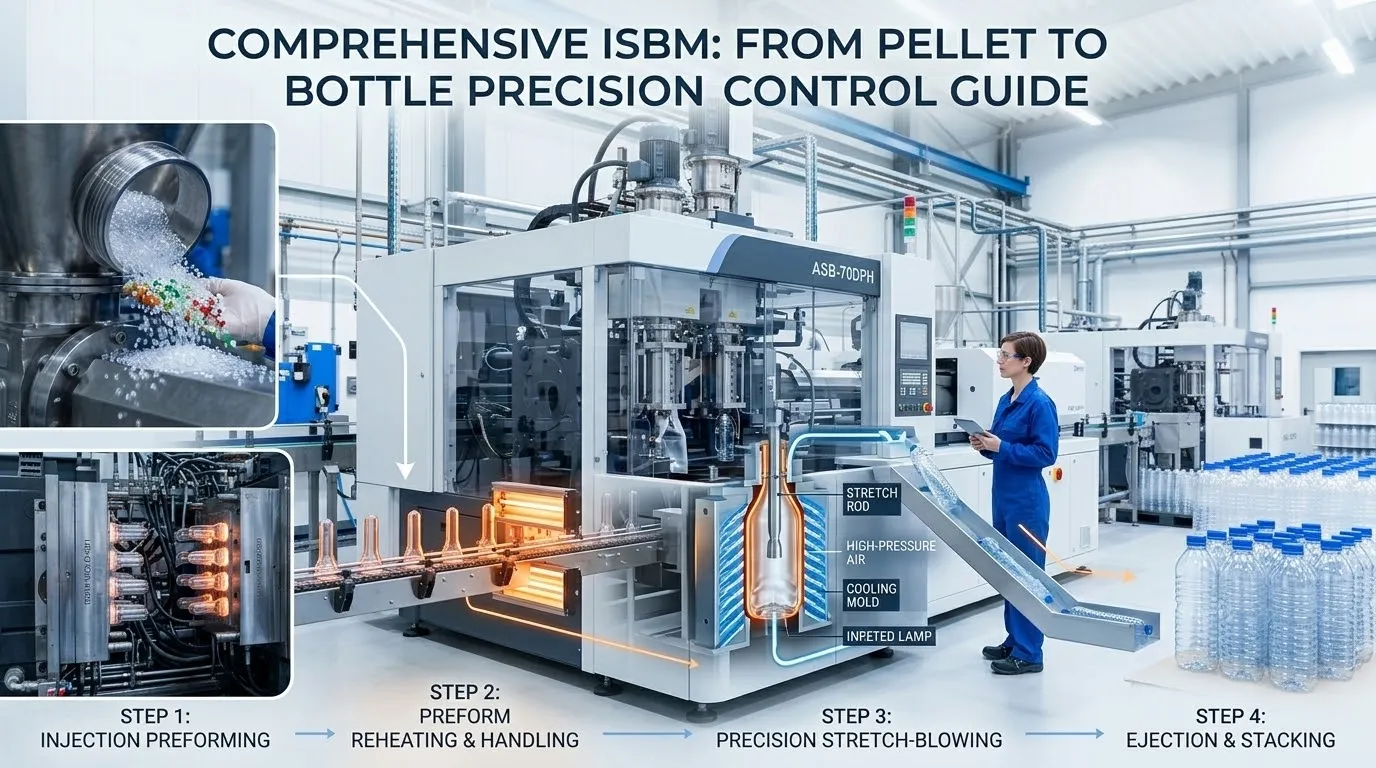
In outdated two-step manufacturing processes, fully cooled preforms must be reheated from room temperature using massive banks of infrared ovens. This external reheating method struggles immensely to penetrate thick plastic walls, frequently resulting in preforms that are scorchingly hot on the exterior skin but dangerously cold within the core. The single-stage ISBM process, however, represents a thermodynamic miracle. In single-stage machinery, the preform is never allowed to fully cool. It is transferred directly from the injection cavity to the conditioning station while actively retaining a massive reservoir of latent core heat.
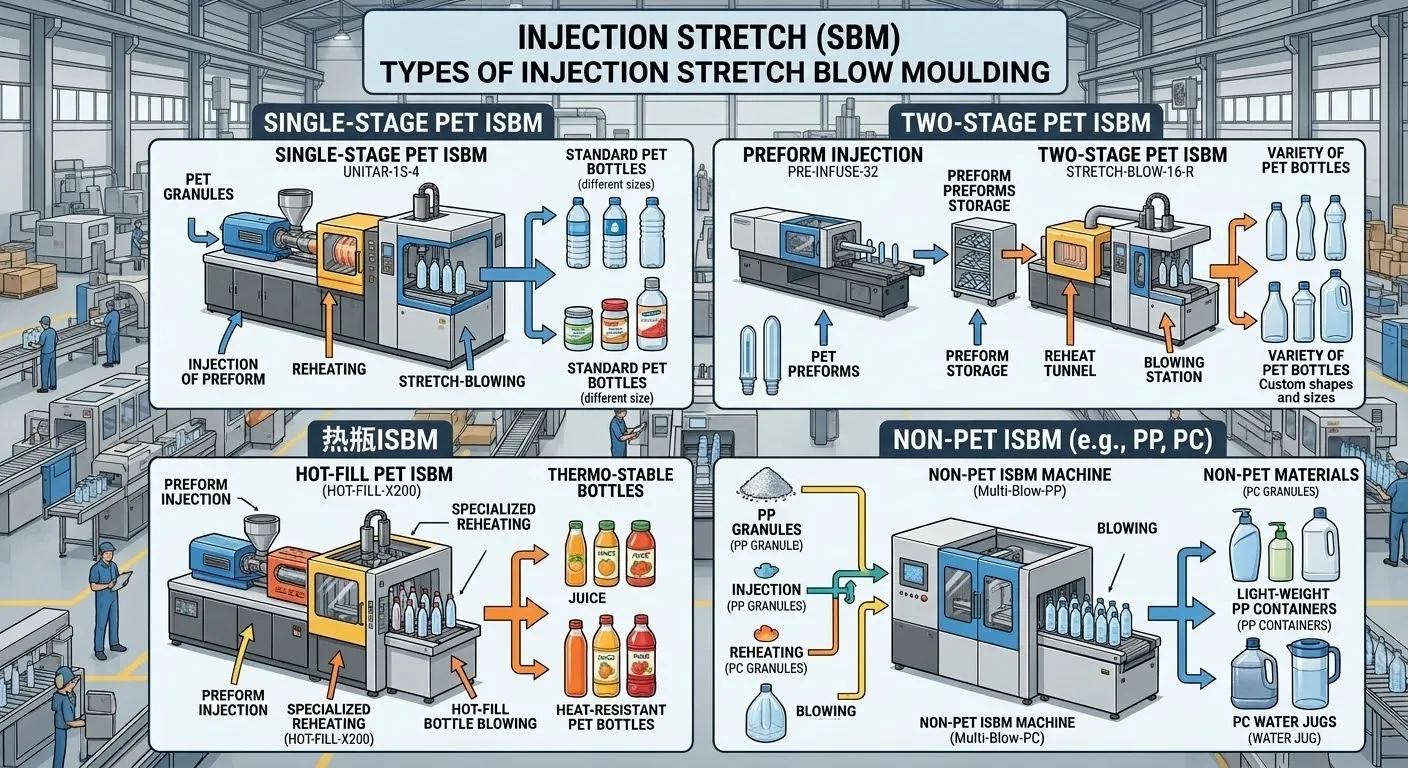
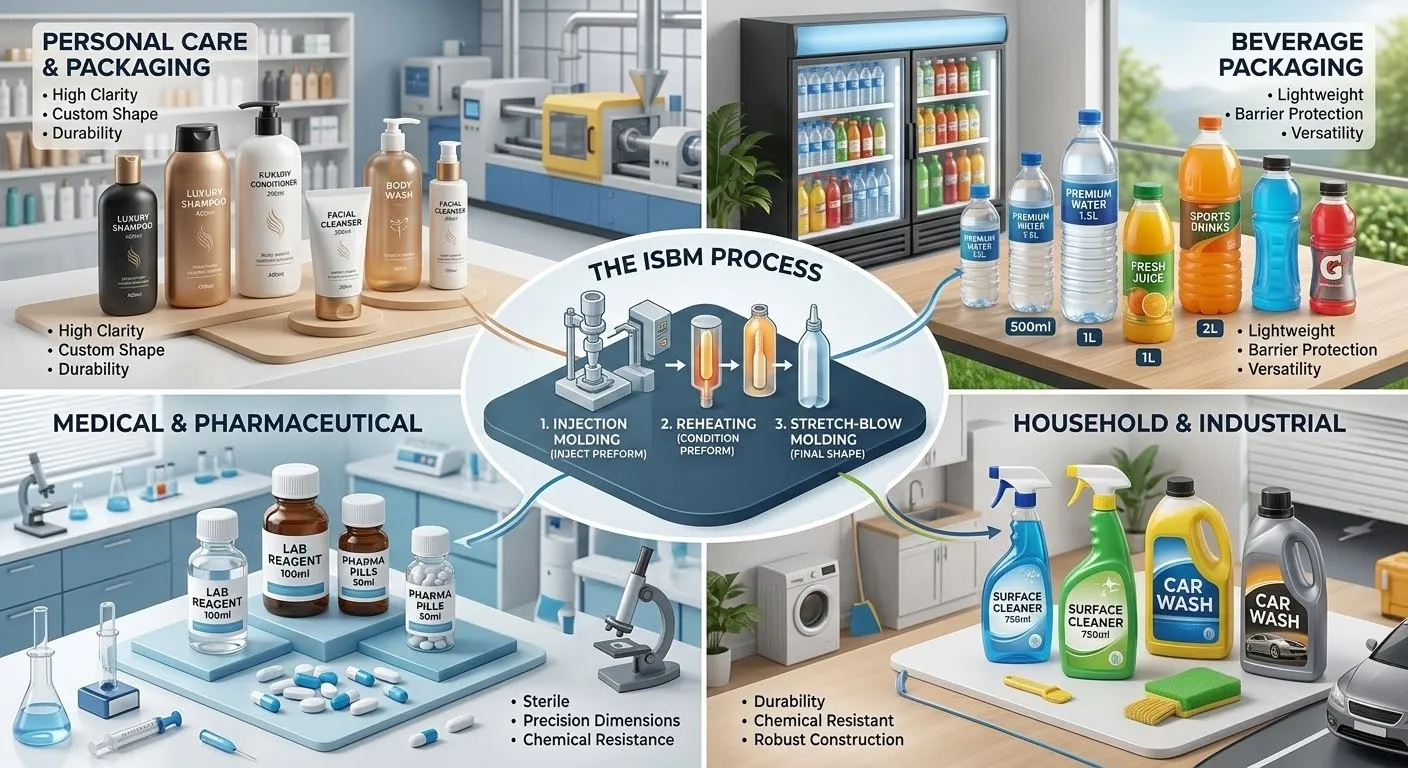
Within the conditioning station, the engineering objective shifts from aggressive heating to delicate thermal redistribution. Conditioning pots, utilizing highly regulated circulating fluids, apply targeted micro-adjustments to the surface of the preform, coaxing the trapped internal latent heat to migrate outward evenly. For highly streamlined operations manufacturing basic, symmetrical cylindrical bottles, Ever-Power engineered the remarkably efficient Macchina per stampaggio a iniezione e stiro-soffiaggio a 3 stazioni EP-BPET-94V3. This specific architecture entirely eliminates the conditioning station. Instead, it relies on our masterful thermodynamic tooling engineers to design injection cooling channels so precise that the preform retains the exact required latent heat gradient to proceed directly to the blow station, shattering cycle time limitations and drastically reducing energy consumption.
However, for the vast majority of premium packaging applications involving thick-walled cosmetic jars or complex household chemical containers, a dedicated conditioning station is an absolute necessity. In universally trusted platforms such as the Macchina per stampaggio a iniezione e stiro-soffiaggio a 4 stazioni EP-HGY150-V4 and the highly versatile Macchina per stampaggio a iniezione e stiro-soffiaggio a 4 stazioni EP-BPET-125V4, operators are granted total control over the conditioning fluid temperatures via the Human-Machine Interface. Optimizing this profile allows technicians to proactively correct dimensional defects. For instance, if a bottle consistently exhibits an off-center base gate, the operator can specifically lower the temperature of the bottom conditioning zone, stiffening the base plastic and physically forcing the descending mechanical stretch rod to anchor perfectly in the center.
Phase Three: Architecting Flawless Axial Heating Profiles
The axial heating profile defines the vertical temperature distribution along the length of the preform, running from the area immediately below the support ledge down to the injection gate at the base. Mastering this vertical thermal gradient is the single most important factor in guaranteeing uniform wall thickness in the final container. During the high-pressure blow phase, expanding polymer will invariably follow the path of least physical resistance, meaning the hottest, softest sections of the preform will stretch earliest and thin out fastest.
1. The Inverted Triangle Profile for Wide-Shoulder Geometries
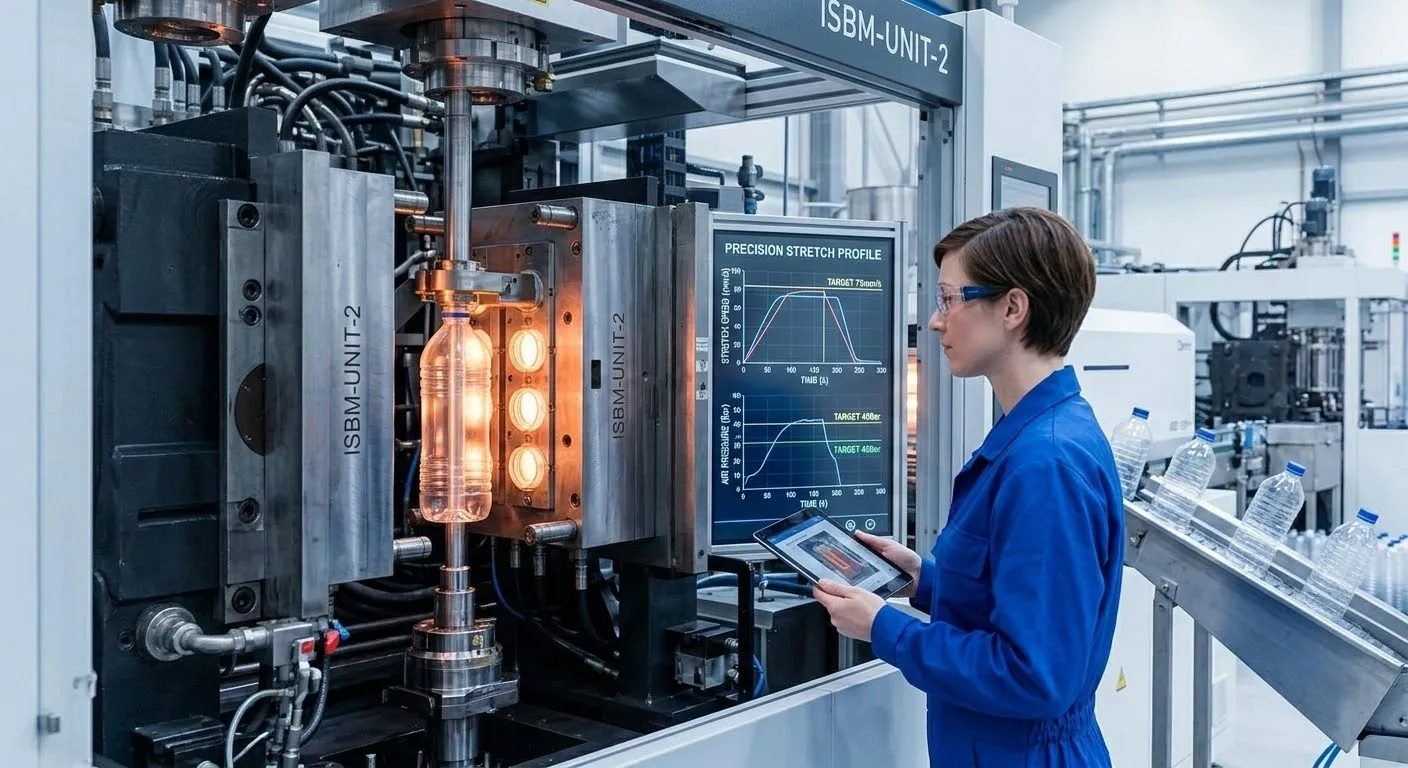
If your new product design features a broad, expansive shoulder profile such as a large luxury shampoo bottle or a trigger spray container the plastic located near the top of the preform must undergo a massive radial displacement to reach the distant corners of the blow mold cavity. To facilitate this, your axial heating profile must resemble an inverted triangle. You must program the conditioning station to apply significantly higher temperatures to the upper body of the preform while actively cooling the mid-body and base regions. This customized thermal gradient ensures that the highly pliable upper plastic rapidly balloons outward to fill the wide shoulders, while the stiffer lower plastic remains structurally dense enough to form a thick, impact-resistant bottle base.
2. The Hourglass Profile for Heavy-Duty Industrial Containers
Conversely, when manufacturing heavy-duty agricultural chemical jugs or thick-based pressurized aerosol containers on our heavy industrial platforms like the Macchina per stampaggio a iniezione e stiro-soffiaggio a 4 stazioni EP-HGY250-V4 or the formidable Macchina per stampaggio a iniezione e stiro-soffiaggio a 4 stazioni EP-HGY200-V4, absolute base thickness is mandatory to pass extreme drop-test protocols. In these scenarios, the axial profile must be meticulously flattened or even manipulated into an hourglass shape, heavily cooling both the neck and the extreme base to lock the material in place, thereby forcing the central body of the preform to absorb the majority of the stretching forces. Executing this complex thermal choreography requires elite PID temperature controllers and perfectly balanced fluid circulation systems.
Phase Four: Conquering Extreme Asymmetry with Radial Heating Profiles
Beyond standard vertical distribution, modern packaging designers consistently push the boundaries of manufacturing physics by introducing wildly asymmetrical geometries. Designs featuring severely off-center handles, extremely flattened flask shapes, or complex, deeply engraved side panels present an immense stretching challenge. In these erratic designs, the preform is required to stretch vastly different distances across its circumference. If an operator applies a uniform, symmetrical heating profile to an asymmetrical design, the side of the bottle requiring the longest stretch will become paper-thin and rupture, while the side requiring minimal stretching will retain a massive, useless clump of dead plastic.
To eliminate this physical dead-end, packaging engineers must deploy Radial Profiling. This advanced technique requires intentionally creating a severe temperature differential around the circumference of the cylindrical preform. The specific longitudinal quadrant of the preform destined to stretch the furthest must be aggressively heated to maximum pliability, while the opposing side must be actively cooled to restrict unwanted expansion.
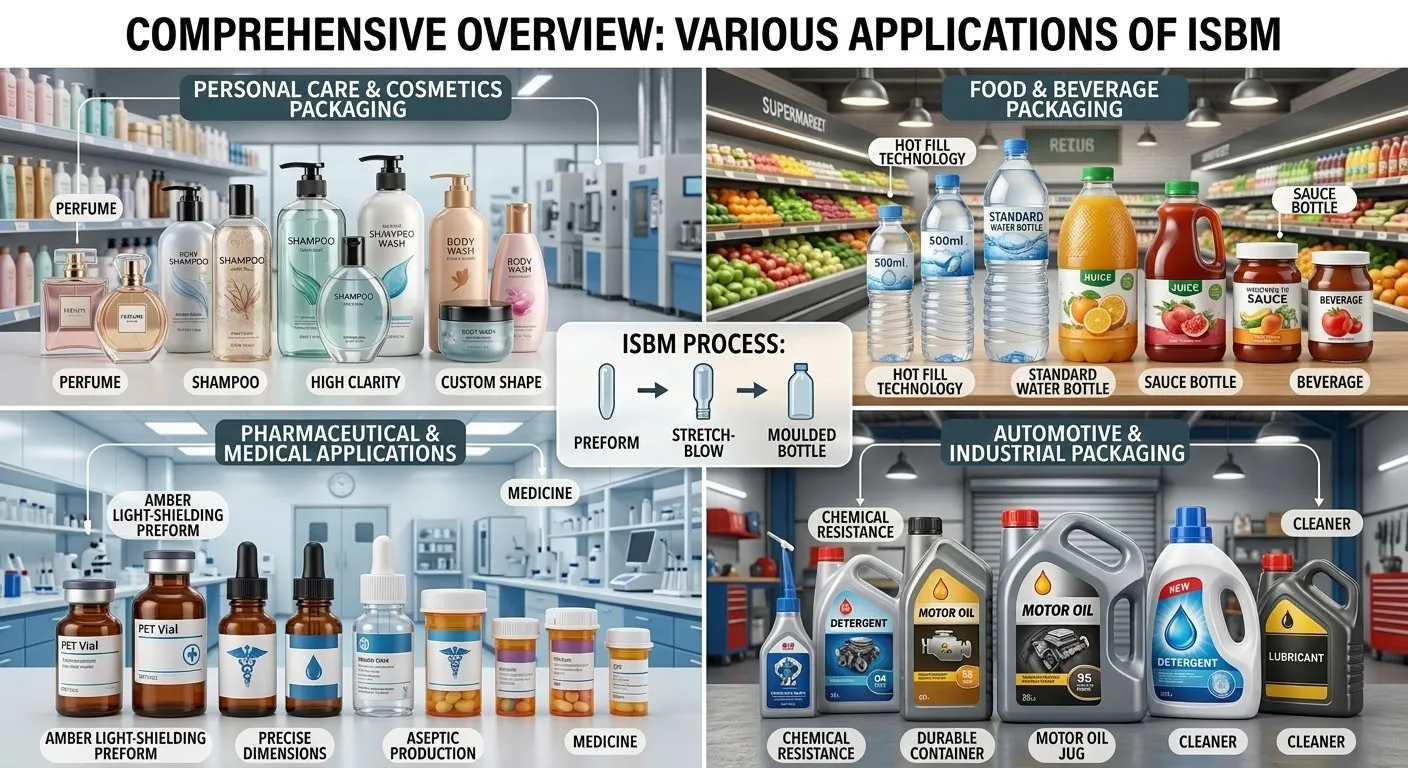
Executing profound radial profiling on standard four-station machinery is incredibly difficult due to spatial and timing constraints. To grant our global clientele absolute, unrestricted design freedom, Ever-Power engineered the ultimate architectural solution: the Macchina per stampaggio a iniezione e stiro-soffiaggio a 6 stazioni EP-HGYS280-V6. This unprecedented technological marvel integrates six fully independent processing workstations. This expanded architecture provides engineers with multiple dedicated thermal conditioning zones, allowing them to execute highly complex, multi-stage radial heat mapping. By slowly and methodically reshaping the thermal circumference of the preform prior to blowing, this six-station leviathan guarantees mathematically perfect wall thickness distribution on the most bizarre, highly asymmetrical designs the industry can conceptualize.
Phase Five: The Critical Role of Injection Tooling in Heating Optimization
Regardless of how highly advanced your machine’s software interface might be, if the physical medium responsible for initial heat extraction the injection mold is poorly engineered, all subsequent heating profile optimization attempts will be futile. In the single-stage ISBM process, the design of the injection mold’s internal water cooling channels directly dictates the uniformity of the latent heat retained by the preform.
Ever-Power rigorously maintains total vertical integration, designing and precision-machining all Stampi per soffiaggio e iniezione personalizzati in un unico passaggio within our Brazilian manufacturing headquarters. Our elite rheology engineers deploy advanced computational fluid dynamics (CFD) software to design hyper-complex conformal cooling networks within the injection cavities. These microscopic water channels intricately mirror the three-dimensional contour of the preform, ensuring that chilled industrial water circulates with highly aggressive, turbulent flow at a perfectly equidistant radius from the hot plastic.
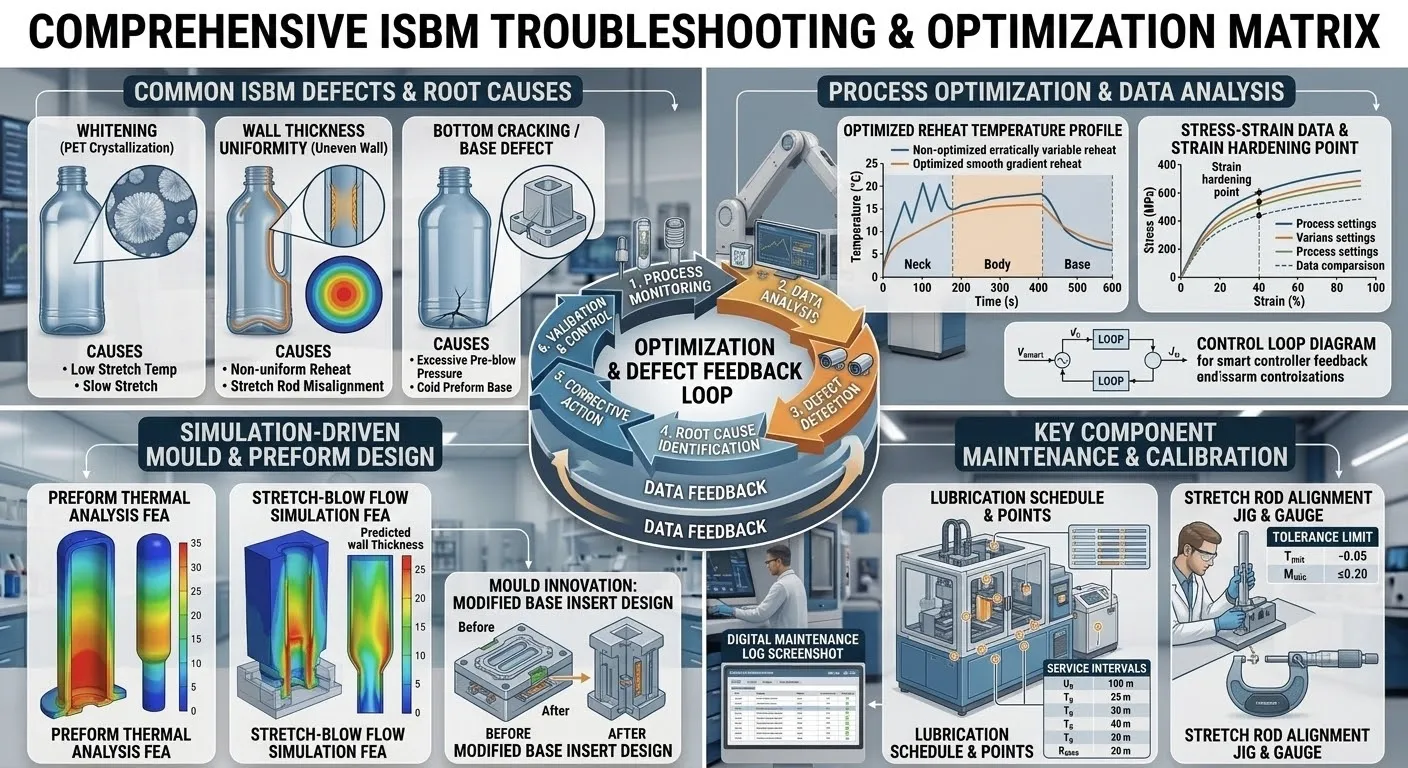
By utterly eliminating thermal blind spots and preventing localized heat pooling, our conformal tooling guarantees that every square millimeter of the preform quenches at an absolutely identical rate. This perfectly uniform baseline thermal canvas allows the subsequent conditioning station heating profiles to deploy with maximum effectiveness, entirely eradicating chronic defects caused by tooling-induced hot spots. For premium cosmetic startups demanding absolute aesthetic perfection without sacrificing agility, pairing our highly compact Macchina per stampaggio a iniezione e stiro-soffiaggio a 4 stazioni EP-BPET-70V4 with our proprietary conformal molds delivers a flawless, world-class manufacturing solution.
Phase Six: Overcoming Thermodynamic Hurdles in Double-Row High-Capacity Platforms
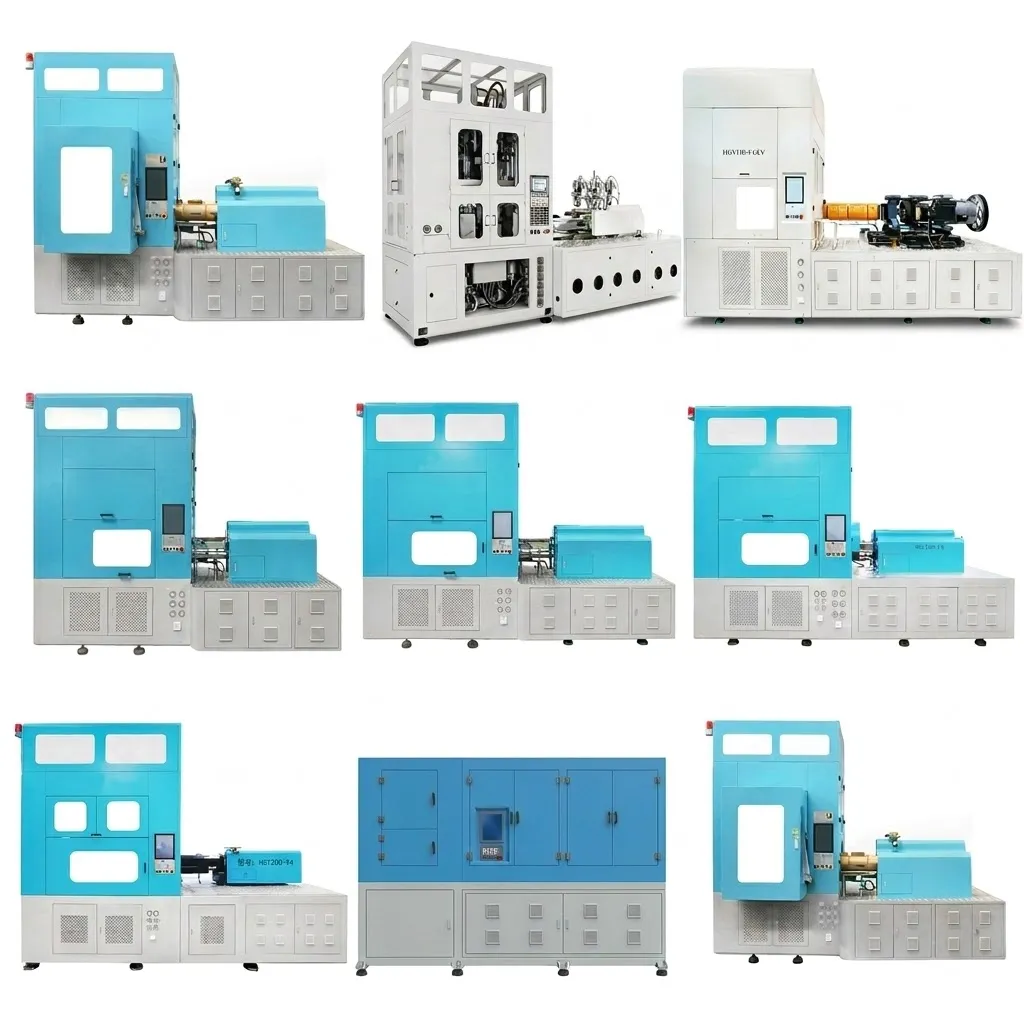
When multinational beverage corporations and heavy industrial chemical suppliers require the production of millions of containers per week, standard single-row machinery capacity is rapidly exhausted. To shatter these physical production ceilings, Ever-Power revolutionized the industry by perfecting the double-row tooling architecture. Dominant high-output platforms like the Macchina per stampaggio a iniezione e stiro-soffiaggio a doppia fila e 4 stazioni EP-HGY250-V4-B e il Macchina per stampaggio a iniezione e stiro-soffiaggio a 4 stazioni EP-HGY200-V4-B successfully inject and blow two parallel rows of containers simultaneously, effectively doubling output per mechanical cycle.
However, maintaining perfect heating profile optimization across a massive double-row mold presents a colossal thermodynamic challenge. Because the front row of cavities and the back row of cavities reside at varying distances from the primary injection nozzle and the main cooling water headers, thermal imbalances are highly probable. If not meticulously engineered, the front row of bottles may emerge crystal clear while the back row suffers from severe stress whitening due to excessive heat loss during transit.
To conquer this instability, Ever-Power equips all double-row platforms with staggeringly complex, perfectly balanced hot runner manifold systems that guarantee identical melt temperatures across all cavities. Furthermore, the massive conditioning stations on these machines are subdivided into highly granular, multi-circuit temperature control zones. Operators can independently manipulate the axial heating profiles of the front row versus the back row via the central processor, completely negating any environmental thermal drift and ensuring that every single bottle among the dozens produced per cycle meets the exact same uncompromising standard of optical perfection.
Phase Seven: Synchronizing Heating Profiles with Servo-Electric Kinematics
A heating profile is not a static, isolated parameter; it is a highly time-sensitive variable that must be perfectly synchronized with the physical movement of the machine. In traditional, aging hydraulic equipment, the speed of the mechanical transfer arms will fluctuate microscopically as the internal hydraulic oil temperature rises and falls throughout a long production shift. These minor kinematic delays are catastrophic for single-stage ISBM. If the machine transfer mechanism hesitates for even a fraction of a second, the highly optimized preform will dissipate its critical latent heat into the ambient factory air, rendering the perfectly programmed heating profile completely useless and resulting in sudden, unexplained spikes in scrap rates.
To forge an unbreakable link between thermodynamic optimization and mechanical execution, the integration of fully electric servo architectures is mandatory. Ever-Power is pioneering this industrial transition with elite platforms such as the Macchina per stampaggio a iniezione e stiro-soffiaggio a 4 stazioni completamente servoassistita EP-HGY150-V4-EV and the highly sterile, cleanroom-ready Macchina per stampaggio a iniezione e stiro-soffiaggio completamente servoassistita EP-HGY50-V3-EV. In these systems, every critical motion from mold clamping to rotary indexing is driven by premium electromagnetic servo motors. These drives operate with terrifying, microsecond precision and are completely immune to fluid temperature fluctuations. This absolute mechanical consistency guarantees that your meticulously tuned heating profile is deployed with one hundred percent efficiency, locking in zero-defect production regardless of external environmental variables.
Phase Eight: Thermal Soaking Strategies for Heavy Industrial Packaging
When manufacturing extreme capacity packaging, such as five-gallon polycarbonate water dispensers or massive, heavy-walled bulk edible oil containers, heating profile optimization collides with the physical limits of thermal penetration. The preforms required for these gigantic containers possess immensely thick plastic walls. Because polymer is a natural thermal insulator, attempting to rapidly heat the core of these thick preforms to the glass transition temperature is incredibly dangerous.
If an operator programs the conditioning station with excessively high temperatures in a desperate attempt to force heat into the center, the outer skin of the preform will instantly overheat, triggering massive thermal crystallization and turning the entire container a hazy, opaque white. Conversely, if the core remains too cold, the immense force of the stretch rod will literally shatter the stiff plastic upon impact. To solve this heavy industrial dilemma, the colossal Macchina per stampaggio a iniezione e stiro-soffiaggio a 4 stazioni EP-HGY650-V4 employs the advanced technique of Thermal Soaking. By combining its massive injection volume with highly extended, lower-temperature conditioning cycles, the machine provides the necessary duration for thermal energy to slowly and safely permeate the thick preform wall. This equalization process ensures the internal and external temperatures reach absolute harmony, guaranteeing that even the largest industrial containers achieve mind-blowing physical strength and pristine optical clarity.
Conclusion: Mastering Thermodynamics to Command the Global Market
Answering the critical question of how to optimize heating profiles for PET preforms transcends basic machinery operation; it is the ultimate determinant of whether a packaging facility will thrive in the lucrative high-end market or collapse under the financial weight of endless material scrap and rejected inventory. The flawless optimization of axial and radial temperature curves is the singular key to unlocking reduced cycle times, eradicating visual defects, and pushing the physical boundaries of container geometry.
As the undisputed engineering powerhouse headquartered in Brazil and dominating manufacturing floors worldwide, Ever-Power encapsulates the profoundly complex equations of polymer thermodynamics within highly reliable, intelligent, and fiercely powerful mechanical architectures. Whether your corporate strategy demands the hyper-agile precision of our boutique platforms, the extreme multi-stage manipulation of our six-station revolutionary designs, or the sheer brute-force output of our double-row industrial titans, the Ever-Power machinery matrix and proprietary tooling technology grant you absolute, uncompromising authority over thermal control.
Redefine Your Core Manufacturing Competency
Do not allow uncontrollable thermal haze, catastrophic stress whitening, and erratic wall distribution to continuously erode your brand reputation and drain your raw material budgets. Ally with the globally recognized engineering authority and integrate the most advanced, precision-controlled thermodynamic manufacturing engines into your production lines to initiate an era of zero-defect, high-velocity output.
Are you fully prepared to execute a deep, comprehensive audit of your current heating profile strategies and existing machinery? Visit our global corporate headquarters at https://isbmmolding.com/, or immediately contact our elite technical diagnostic team directly at [email protected] to secure bespoke thermodynamic equipment solutions and profound process consultation.