What is a PET preform and how is it made?
A PET preform is the thick-walled injection-moulded intermediate from which a finished PET bottle is produced by stretch blow moulding. It resembles a thick-walled test tube: closed at one end, with the finished bottle’s neck thread already formed at the open end. The preform contains all the material that will form the final bottle, and its dimensions, weight, and wall thickness distribution are the primary determinants of the finished bottle’s performance. Understanding what a preform is and how it is made is fundamental to understanding ISBM bottle production.
The Anatomy of a PET Preform
A PET preform has three distinct zones: the neck finish (the threaded area above the support ledge), the body (the thick-walled tube below the neck), and the base (the closed dome at the bottom). Each zone plays a different role in the finished bottle:
- Neck finish: formed in the injection mould and not stretched during blowing — it becomes the bottle’s closure area. The neck finish dimensions are critical for closure compatibility; any dimensional error here cannot be corrected by the blow step.
- Body: the main area that is stretched and blown to form the bottle sidewall. Body wall thickness in the preform determines the final bottle’s sidewall thickness after stretching.
- Base: forms the bottle base dome through a combination of axial stretch rod extension and radial blow. The base is typically the area where wall thickness is most difficult to control and where stress whitening defects most commonly appear if stretch ratios are exceeded.
How a Preform Is Made in One-Step ISBM
In a one-step ISBM machine, the preform is made at the injection station, which is the first station on the machine’s rotary table. Dried PET resin is fed from the hopper into the barrel, where the reciprocating screw melts it at 270–295 °C and accumulates a measured shot. The screw then advances axially, injecting the melt through the hot runner nozzle into the closed preform mould cavity at 800–1,500 bar. The melt fills the cavity from gate (at the base of the preform) to neck, forming the complete preform geometry including the thread.
The preform then cools in the mould for 2–8 seconds, reducing its surface temperature to approximately 60–75 °C — cool enough to eject without distortion but still retaining substantial internal heat. The mould opens and the preform is transferred, still on its mandrel (neck insert), to the conditioning station where infrared heaters adjust its temperature profile. This transfer happens while the next shot is already being injected at the injection station — all stations operate simultaneously in every machine cycle.
The key feature of one-step ISBM preform manufacture is that the preform is never cooled to ambient temperature. It retains its injection heat through conditioning and into the blow step, which is the source of one-step’s thermal efficiency advantage over two-step processes.
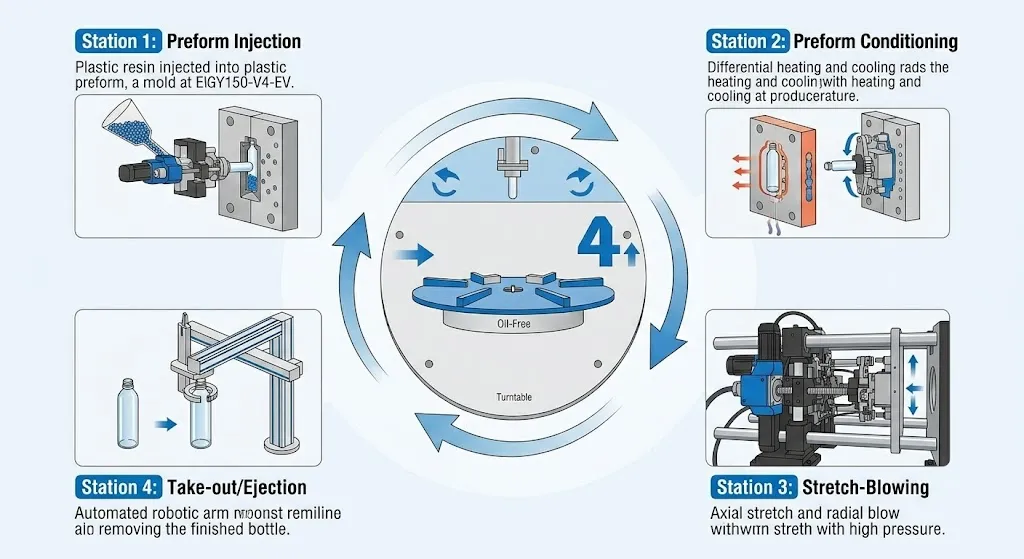
4-station ISBM process on the EP-HGY150-V4-EV — the preform is injection-moulded at station 1, conditioned at station 2, stretch-blown at station 3, and ejected as a finished bottle at station 4.
How a Preform Is Made in Two-Step Production
In two-step PET bottle production, preforms are made in a dedicated preform injection moulding machine — a high-cavity hot runner injection machine from suppliers such as Husky, Sipa, or Netstal. These machines produce preforms in large quantities (typically 8–96 cavities per machine) that are fully cooled, inspected, and packaged for storage and subsequent transport to the blow moulding step. Preforms made in the two-step process are identical in geometry to those made in one-step machines, but they have been cooled to ambient temperature and must be fully reheated in the infrared oven of the reheat blow moulding machine before they can be stretched and blown.
Key Preform Design Parameters
The preform design determines many critical properties of the finished bottle before any blow parameters are set. The key design parameters are:
| Parametro | Effect on Finished Bottle |
|---|---|
| Preform weight (grams) | Directly sets finished bottle weight — no material is added or removed during blowing |
| Body wall thickness | Determines finished sidewall thickness after stretch; thicker wall = thicker bottle sidewall |
| Body length | Sets axial stretch ratio when blown to final bottle height |
| Neck finish dimensions | Directly transferred to bottle; must match closure specification |
| Gate geometry | Affects base clarity and base thickness distribution in finished bottle |
| IV of processed PET | Determines molecular weight after processing; affects bottle mechanical performance |
Preform Quality: What to Inspect
First-article preform quality inspection should cover: weight (against specification ± tolerance); wall thickness at body, shoulder, and gate zone (using ultrasonic or destructive cross-section measurement); neck finish dimensions (thread OD, thread pitch, support ledge diameter, and height) against the closure gauge; gate vestige height and diameter; and visual inspection for surface defects (splay, hazing, gate sink, or flow lines). Any preform quality issue identified at first article can be corrected at the mould stage; the same issue discovered after a production run of 500,000 bottles is significantly more expensive to address.
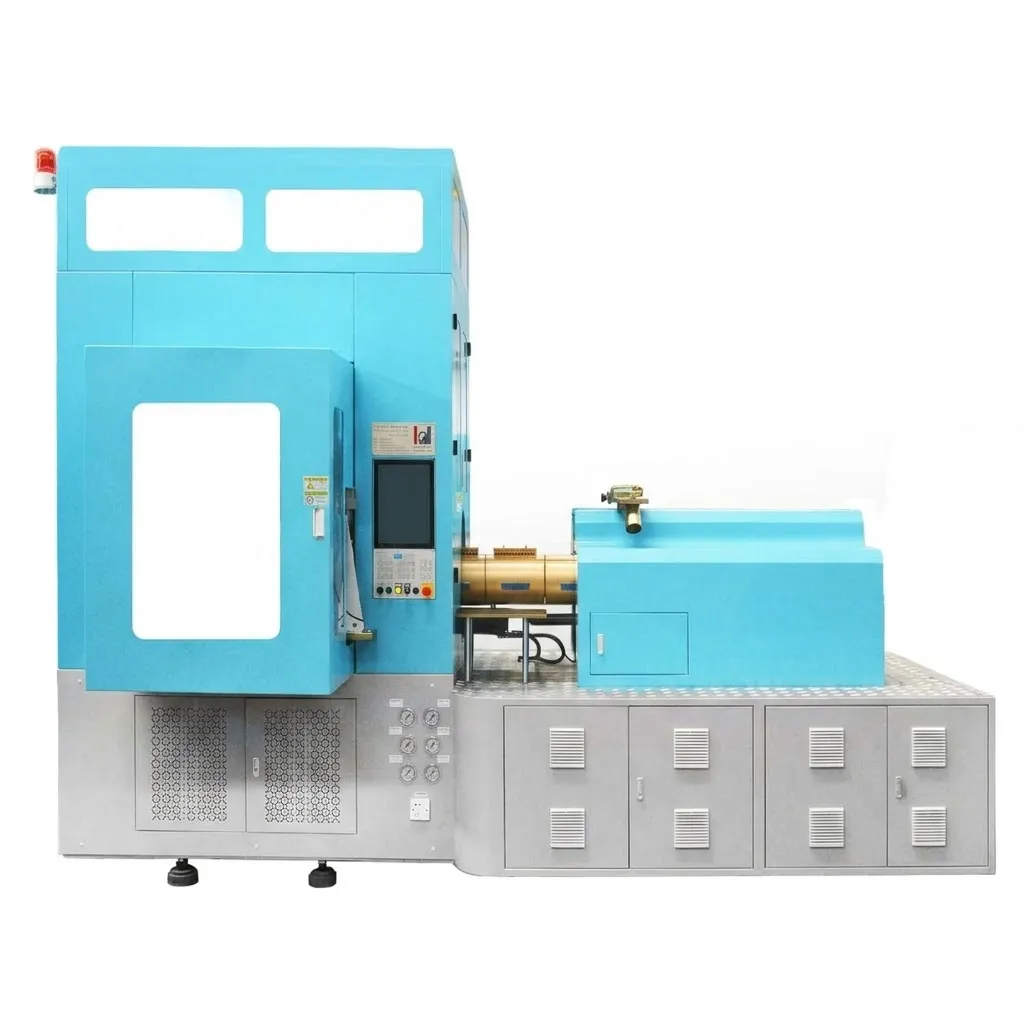
Custom ISBM mould set — the preform mould (left) produces the injection-moulded preform intermediate; the blow mould (right) defines the finished container shape.
Need a preform and mould design for your PET bottle?
Ever-Power designs preforms and matched ISBM mould sets for every container in the EP-HGY machine range. Send your bottle drawing and resin specification for a preform feasibility review and mould quotation within 48 hours.
Explore custom ISBM mould sets including preform mould design, or browse the gamma completa di macchine to understand which model is right for your preform weight and bottle volume.
Domande frequenti
Can I use preforms made on a third-party injection machine in a one-step ISBM machine?
No. One-step ISBM machines are designed to injection-mould their own preforms in the injection station. They are not compatible with externally made preforms because the preform mandrel geometry, neck insert dimensions, and conditioning station are configured for the specific preforms made by that machine. If you want to use externally made preforms, a two-step reheat blow moulding machine is the correct equipment, not a one-step ISBM machine.
How does preform design affect bottle clarity?
Preform wall thickness distribution directly affects the uniformity of biaxial orientation in the finished bottle, which in turn affects optical clarity. Areas with uneven orientation — typically caused by uneven preform wall thickness or uneven conditioning temperature — appear hazy or milky in the finished bottle. Correct preform design distributes material evenly around the body circumference and along its length, and the conditioning temperature profile is adjusted to compensate for any remaining wall thickness variation. Mirror-finish preform mould cavities (Ra ≤ 0.05 μm) also contribute to bottle surface clarity by minimising surface micro-roughness in the preform that carries through to the finished bottle.
What is the typical preform weight for a 500 ml PET water bottle?
A 500 ml PET water bottle for ambient-fill applications typically weighs 8–12 grams. The preform weight equals the finished bottle weight — no material is added or removed during blowing. Lightweight water bottle designs using high-stretch-ratio preforms and modern neck finish designs can achieve 8–9 grams for standard 500 ml formats. Bottles for hot-fill or carbonated applications require heavier preforms (12–18 grams) to achieve the additional wall thickness needed for thermal stability or pressure resistance.
How Preform Design Affects Bottle Light-Weighting
Light-weighting — reducing the bottle’s total resin weight while maintaining or improving its performance specifications — is one of the most commercially valuable outcomes of optimised preform design. In the ISBM process, the preform weight equals the finished bottle weight; reducing the preform weight by one gram reduces the finished bottle weight by one gram. At a resin price of USD 1.20 per kilogram and an annual production of 5 million bottles, each gram of weight reduction saves USD 6,000 per year in resin cost.
Light-weighting is achieved by reducing preform wall thickness in the body zone while maintaining neck finish thickness (which must remain adequate for closure torque performance) and base thickness (which must survive drop impact at the thinnest point). The limit on how thin the preform body can be made is set by the minimum wall thickness that can be reliably produced by injection moulding without short shots or flow defects, and the minimum bottle wall thickness that meets the finished container’s structural requirements. Modern ISBM preform designs for 500 ml PET water bottles achieve 8–9 gram total weights using preform body walls of 2.5–3.0 mm at a 2.5× axial stretch ratio and 4.5× hoop blow ratio.
Ever-Power’s mould design team can review your current preform design for light-weighting opportunities as part of the mould feasibility review. Typical light-weighting projects achieve 1–3 gram reductions on standard 500 ml PET water bottle formats without compromising drop test or top-load performance.
Preform Storage and Handling in Two-Step Operations
While one-step ISBM eliminates all preform storage and handling by keeping the preform within the machine from injection to ejection, understanding preform storage is still relevant for buyers who operate two-step systems or who purchase preforms from external suppliers for downstream blowing. Preforms cooled after injection must be stored in conditions that prevent moisture reabsorption (PET preforms in humid environments can absorb sufficient moisture to affect subsequent blow quality), physical damage to the neck finish threads (which must remain within gauge for closure compatibility), and contamination of the preform interior (which will transfer to the bottle interior).
Standard preform storage recommendations: cool, dry storage area (below 25 °C, below 60% relative humidity); sealed octabins or cardboard boxes with polyethylene liners to prevent moisture ingress and physical damage; maximum storage time before blowing of 6 months for food-contact applications and 3 months for pharmaceutical (longer storage increases the risk of AA content build-up from further post-condensation reactions and ambient degradation of the PET). For one-step ISBM buyers, none of these storage requirements apply — the preform goes directly from injection to conditioning to blowing without any storage step, which is one of the operational advantages of one-step over two-step that is easy to overlook when comparing the two processes on capital cost alone.