Bagaimana cara mengurangi konsumsi energi dalam produksi ISBM?
Energy cost is typically the second-largest variable operating cost in ISBM production after resin, and the largest single controllable cost beyond the initial machine purchase. For an ISBM machine running two shifts a day, 250 days a year, energy savings of 30–45% through drive system and process optimisation represent USD 8,000–25,000 in annual cost reduction depending on machine size and local electricity price. This guide covers every lever available to reduce energy consumption in one-step ISBM production, in order of impact.
Lever 1: Drive System Selection — The Biggest Single Saving
The most impactful energy reduction decision in ISBM is made at machine purchase: choosing a servo-hydraulic or full-servo (all-electric) drive system over a fixed-speed hydraulic pump. Fixed-speed hydraulic pumps run continuously at full motor speed regardless of whether the machine is actively clamping, injecting, or in a dwell period. Energy is consumed even when the hydraulic system is not performing useful work, because the pump pressure must be maintained. A servo-hydraulic system runs the pump motor on demand only, matching hydraulic flow precisely to the instantaneous requirement and consuming zero pump energy during dwell periods.
The measured energy saving of servo-hydraulic over fixed-speed hydraulic on ISBM machines is consistently 30–45% in commercial production conditions — not a theoretical figure, but verified from installed machine consumption data. A full-servo (all-electric) machine, which replaces all hydraulic axes with servo-motor-driven mechanical systems, achieves 40–55% energy saving over fixed-speed hydraulic. All EP-HGY and EP-BPET machines use servo-hydraulic or full-servo drive as standard. If you are operating a fixed-speed hydraulic ISBM machine, retrofitting a servo-hydraulic pump system (where the machine’s hydraulic circuit design allows) is the single highest-ROI energy investment available for that machine.
Lever 2: Reduce Desiccant Dryer Energy
The desiccant dryer for PET resin is typically the second-largest energy consumer in an ISBM production cell, after the machine itself. Standard desiccant dryers operate at 160–170 °C and consume significant energy for both the heating element and the desiccant regeneration cycle. Several measures reduce dryer energy without compromising drying effectiveness:
- Right-size the dryer to the machine: a dryer with 2× the capacity needed for the machine’s throughput wastes energy heating air through an oversized desiccant bed. Size the dryer to 110–130% of the machine’s hourly resin consumption, not to a larger safety margin.
- Use dew point control: modern desiccant dryers with dew point sensors switch regeneration cycles based on actual desiccant saturation rather than a fixed timer, reducing regeneration energy by 20–40% compared to timer-controlled systems.
- Insulate dryer connections: insulating the hose between the dryer and the machine hopper reduces heat loss and allows the dryer to maintain the target temperature with less energy input.
Lever 3: Optimise Conditioning Heater Profiles
The conditioning station infrared heaters are significant energy consumers on 4-station and 6-station ISBM machines. Each heater zone runs continuously at its setpoint temperature during production, regardless of whether the conditioning step is limiting the cycle time or is completing well within the injection station’s available time. Heater energy can be reduced by: setting the minimum number of active heater zones required to achieve the target preform temperature profile (zones not needed for a specific bottle format should be switched off, not just reduced); using pulse-width modulation (PWM) control where available to reduce heater energy during dwell periods within the conditioning step; and confirming that the target conditioning temperature is the minimum needed to achieve acceptable bottle quality rather than a conservative overshoot of the process window.
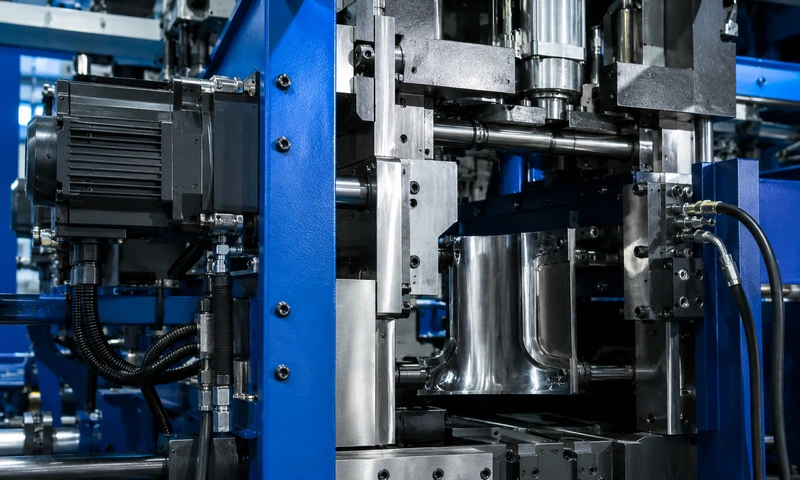
Servo-hydraulic drive on the EP-HGY series — on-demand pump operation is the single most impactful energy reduction measure available in ISBM production, saving 30–45% versus fixed-speed hydraulic.
Lever 4: Reduce Blow Air Pressure
High-pressure blow air at 25–40 bar is generated by a dedicated booster compressor and represents a significant energy cost in the ISBM production cell. Several measures reduce blow air energy without compromising bottle quality:
- Use the minimum blow pressure that achieves acceptable bottle quality: many ISBM machines are set to maximum blow pressure as a conservative default. Reducing blow pressure in 1–2 bar increments while monitoring bottle quality (sidewall clarity, base formation, top-load performance) typically allows 3–8 bar of reduction from the default setting, with a proportional reduction in compressor energy.
- Implement blow air recovery: some ISBM machine designs allow the high-pressure air used in the blow step to be partially recovered after bottle ejection and recycled back into the compressor system, reducing net air consumption per cycle by 15–30%.
- Check for air leaks regularly: leaks in the high-pressure air circuit (blow pin seals, stretch rod seals, blow valve seats) waste compressor output directly. A formal air leak inspection programme every 100,000 cycles finds and eliminates the most common sources of energy waste in the high-pressure air system.
Lever 5: Reduce Cycle Time
Reducing cycle time increases the number of bottles produced per hour for the same machine energy consumption, which reduces the energy cost per bottle even if total machine energy consumption stays constant. Cycle time reduction is achieved through: optimising cooling water flow and temperature in the injection mould (reducing cooling time within the injection cycle); optimising the blow mould cooling circuit for faster bottle cooling; and using the 6-station machine configuration (EP-HGYS280-V6), which allows shorter mould hold times by using a post-blow cooling station to complete bottle cooling off the blow mould.
Lever 6: Production Scheduling
Energy cost per bottle is also affected by production scheduling decisions. Running the machine at continuous high output rates is more energy-efficient than frequent starts, stops, and idle periods. Machine startup from cold consumes significant energy in barrel heating, dryer cycling, and mould temperature conditioning. A production schedule that consolidates smaller runs into longer continuous runs, with planned format changes rather than unplanned interruptions, reduces the number of startups per week and the associated energy overhead. Where possible, schedule mould changeovers immediately after the end of one production run (while the machine is still at operating temperature) rather than after a cold shutdown, to avoid the energy cost of a second full warm-up cycle.
Want to calculate the energy saving of upgrading to a servo-hydraulic ISBM machine?
Ever-Power can calculate the expected annual energy saving for your specific production volume and local electricity price when upgrading from fixed-speed hydraulic to the EP-HGY servo-hydraulic range. Contact our technical team with your current machine’s energy consumption data.
Browse the EP-HGY range with servo-hydraulic and full-servo specifications, or contact us to discuss upgrading your existing ISBM production line to a more energy-efficient configuration.
Pertanyaan yang Sering Diajukan
How much does a servo-hydraulic upgrade cost versus a new machine?
For most ISBM machines, retrofitting a servo-hydraulic pump system costs USD 8,000–20,000 depending on machine size and hydraulic circuit design. This is significantly less than a new machine purchase but requires confirming that the specific machine model is mechanically compatible with a servo-hydraulic retrofit. Some older machine designs have hydraulic circuit configurations that do not allow clean servo-hydraulic integration. If a retrofit is not practical, replacing the machine with a new servo-hydraulic model should be evaluated on total cost of ownership over 10 years, including the energy saving from the new machine, versus the capital cost of replacement.
What is the energy consumption of an EP-HGY150-V4 machine?
Actual energy consumption depends on bottle weight, cycle time, and cavity count. As a representative example, an EP-HGY150-V4 running 500 ml PET water bottles at 2 cavities and a 7-second cycle time typically consumes 8–12 kWh per hour at full production speed, including dryer and compressor. This equates to approximately 4–6 kWh per 1,000 bottles, or USD 0.0004–0.0009 per bottle at USD 0.10/kWh. Contact Ever-Power for guaranteed energy consumption data for specific machine models and production parameters.
Can energy savings be verified before purchasing a new ISBM machine?
Yes. Request energy consumption data from the supplier for the specific machine model you are evaluating, measured in kWh per 1,000 bottles at your specific bottle weight and cycle time. Ask for this measured from a running production machine, not a theoretical calculation. Some suppliers will provide an energy measurement guarantee in the purchase contract — a commitment that the installed machine will not exceed a specified kWh per 1,000 bottles under defined production conditions. This type of contractual energy guarantee is the strongest evidence of real-world efficiency.
Measuring and Benchmarking ISBM Energy Performance
Before implementing energy reduction measures, establishing a baseline energy measurement is essential. Measuring ISBM energy consumption correctly requires monitoring at the machine power input (kWh per hour from the supply breaker), the dryer (separately sub-metered), and the compressor (separately sub-metered or calculated from air flow and compressor efficiency). Dividing the combined kWh per hour by the bottles-per-hour output gives the kWh per 1,000 bottles metric, which is the most useful benchmark for comparing energy performance across machine models, drive systems, and production speeds.
Published energy benchmarks for ISBM production vary widely depending on bottle weight, cycle time, and drive system. As a general reference: a well-optimised servo-hydraulic ISBM machine producing 500 ml PET water bottles at 1,200 bottles per hour should achieve 3–6 kWh per 1,000 bottles (combined machine, dryer, and compressor). An equivalent full-servo machine achieves 2–4 kWh per 1,000 bottles. An older fixed-speed hydraulic machine at equivalent output typically consumes 7–12 kWh per 1,000 bottles. These benchmarks are useful for identifying whether an existing machine is performing at the expected energy level or whether process optimisation or equipment improvement is needed to close a gap.
For accurate ongoing monitoring, install sub-meters on the machine, dryer, and compressor separately. This allows you to identify which component is responsible for any energy increase and target the specific corrective action required. Trend monitoring of energy per 1,000 bottles over time also provides early warning of equipment degradation — increasing energy consumption at constant output often indicates developing mechanical issues (pump wear, seal leakage, compressor efficiency degradation) before they cause a quality or production problem.