ब्लो मोल्डिंग के क्या नुकसान हैं?
Every manufacturing process has genuine limitations, and blow moulding is no exception. Understanding the real disadvantages of blow moulding — and which apply specifically to ISBM versus EBM or IBM — allows buyers to make better-informed equipment decisions and set realistic expectations for what the process can and cannot achieve in production.
Limitation 1: Restricted to Hollow Parts
Blow moulding can only produce hollow containers. The process relies on air pressure expanding a plastic preform against a mould wall — a mechanism that requires an enclosed internal volume to pressurise. Solid plastic components cannot be produced by blow moulding; injection moulding is required for those.
Limitation 2: Size Upper Limit in ISBM
One-step ISBM machines are limited to containers of approximately 10 litres maximum by the injection clamping force available in a compact rotary table format. For containers larger than 10 litres, extrusion blow moulding is the standard alternative.
Limitation 3: Complex Non-Round Shapes Are Difficult
The biaxial blow step in ISBM inherently favours rotationally symmetrical shapes. Bottles with circular cross-sections blow uniformly because air pressure expands the preform equally in all hoop directions. Strongly non-round cross-sections — square or hexagonal footprints — are difficult to achieve with acceptable wall thickness distribution, and some geometries are impractical on ISBM machines entirely.
Limitation 4: High Mould Investment
ISBM mould sets — preform mould, blow mould, and stretch rod — represent a significant capital investment. A complete mould set for a standard 2-cavity PET bottle typically costs USD 20,000–40,000. Multi-cavity moulds for complex shapes can reach USD 80,000 or more. This mould investment is required for every new container format and must be amortised over production volume.
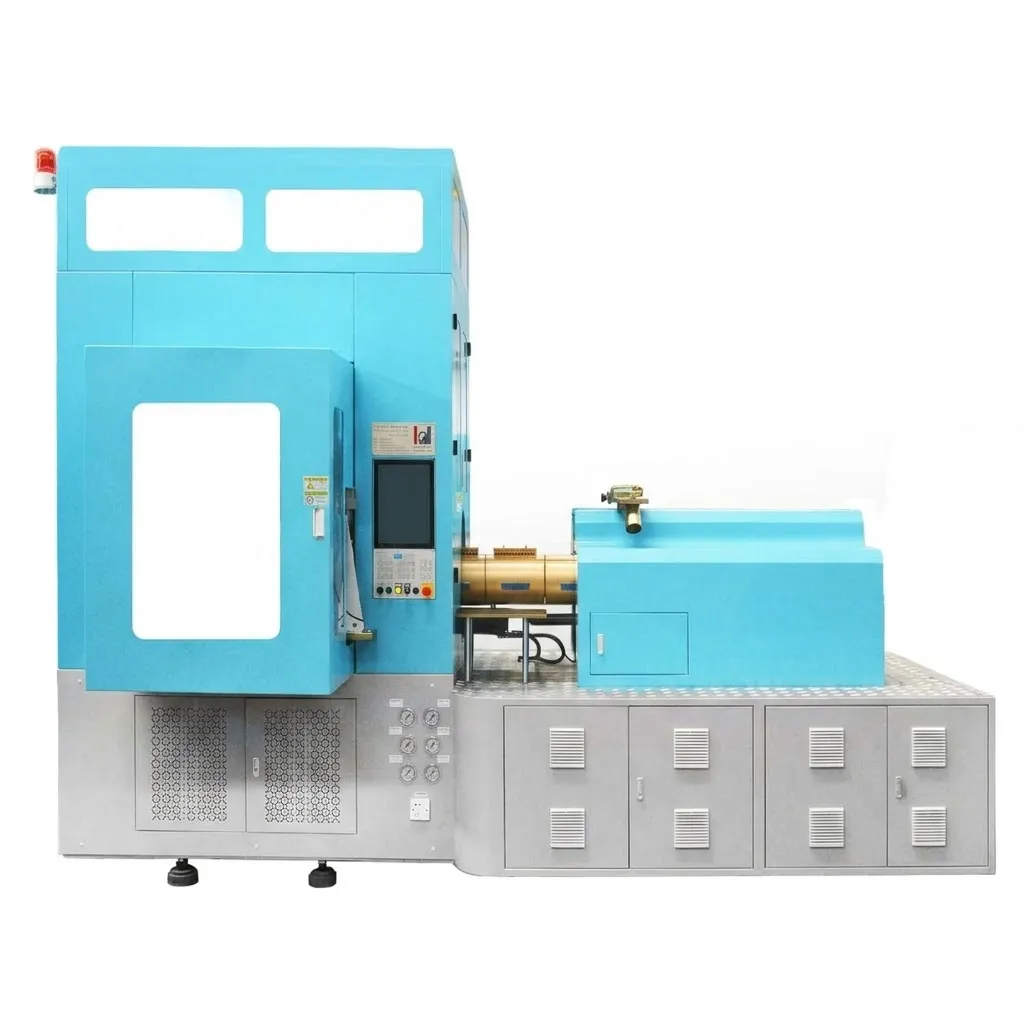
The ISBM mould investment covers three components: preform mould, blow mould, and stretch rod. It is the primary barrier to entry for small-volume producers.
Limitation 5: Wall Thickness Control Requires Expertise
Achieving consistent wall thickness distribution — particularly for complex shapes — requires experienced process engineers and well-designed tooling. Wall thickness in a blown container is determined by the interaction of preform geometry, conditioning temperature profile, stretch rod speed, blow pressure, and blow timing. Optimising all of these for a new bottle format takes systematic development time and produces some start-up scrap.
Limitation 6: Lower Output Than Two-Step at Very High Volumes
At very high production volumes — above 20,000–40,000 bottles per hour for a single format — two-step reheat stretch blow moulding (RSBM) machines achieve higher throughput than one-step ISBM because they decouple the injection cycle time from the blow cycle time. For commodity volumes at major water or CSD brands, two-step RSBM is typically the more efficient choice.
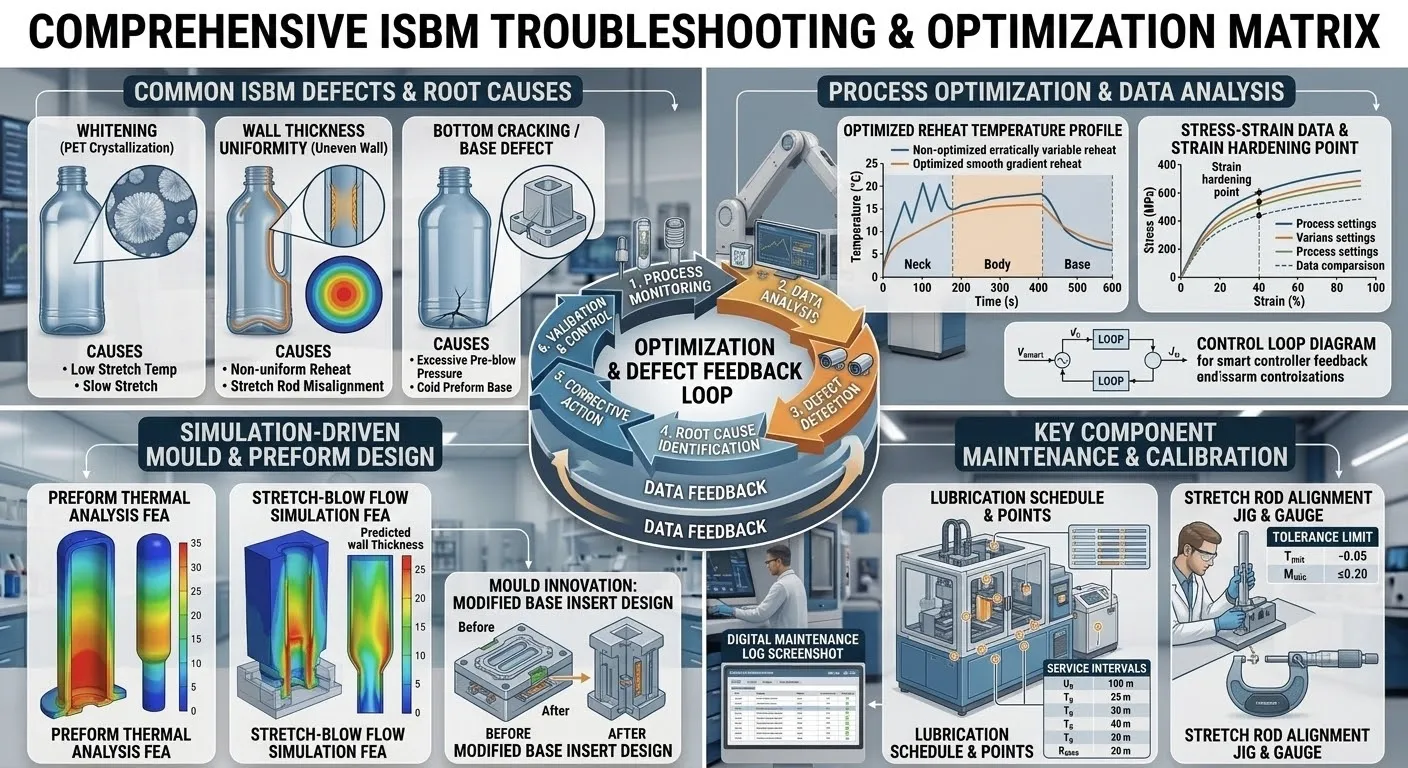
Systematic process optimisation addresses many of ISBM’s operational limitations — wall thickness consistency, scrap rate, and cycle time can all be improved through structured parameter development.
Putting the Disadvantages in Context
These limitations are real, but they must be weighed against what one-step ISBM uniquely achieves: a finished, biaxially oriented, glass-clear, lightweight PET container produced from resin pellets in a single integrated machine cycle. For pharmaceutical, cosmetic, food, and beverage applications at mid-volume, ISBM’s advantages substantially outweigh its limitations.
Want to discuss whether ISBM is the right process for your container?
Ever-Power’s applications team can review your container specification and confirm whether one-step ISBM is optimal for your volume, format, and market requirements.
See the ईपी-एचजीवाई और ईपी-बीपीईटी आईएसबीएम मशीनों की पूरी श्रृंखलाया अन्वेषण करें कस्टम मोल्ड विकल्प to understand the full tooling investment.
अक्सर पूछे जाने वाले प्रश्नों
Is blow moulding wasteful of material?
ISBM is among the most material-efficient container manufacturing processes. Biaxial orientation provides structural strength at very thin wall sections, so ISBM bottles use substantially less resin per unit of contained volume than any alternative. A 500 ml PET water bottle produced by ISBM weighs 8–10 g; an equivalent unoriented injection-moulded container would require 30–50 g.
What is the minimum production volume for viable ISBM?
The break-even point depends on purchased container price, in-house production cost, and mould investment. For most pharmaceutical and cosmetic applications, in-house ISBM becomes economically viable at annual volumes above 500,000–1,000,000 bottles per format. At lower volumes, contract blow moulding is usually more economical.
How long does new format process development take?
First-article process development on a new mould typically takes 4–16 hours of trial time depending on bottle complexity and operator experience with similar formats. This is a one-time investment per mould that does not repeat once the process recipe is saved. Ever-Power provides process documentation and on-site commissioning support to minimise development time on new installations.