How to choose a blow molding machine manufacturer?
Choosing a blow moulding machine manufacturer is one of the most significant capital decisions a packaging producer makes. The wrong choice — a machine that underperforms, a supplier with no support in your market, or a process type that does not match your container — costs far more in lost production and remediation than any price saving achieved at the time of purchase. This guide covers every criterion that matters in a rigorous supplier evaluation, with specific reference to one-step ISBM machine procurement.
Step 1: Clarify the Machine Type You Actually Need
Before evaluating any manufacturer, confirm which blow moulding process is correct for your container. The three main types — extrusion blow moulding (EBM), injection blow moulding (IBM), and injection stretch blow moulding (ISBM) — are served by different manufacturers and are not interchangeable. EBM is the right process for large HDPE containers and those with integral handles. IBM is the right process for small pharmaceutical and personal care containers in HDPE or PP where neck finish precision is the priority. ISBM is the right process for PET, PP, and PETG bottles requiring biaxial orientation, glass-like clarity, and light weight — water bottles, pharmaceutical oral dose containers, cosmetic flacons, edible oil containers, and agrochemical bottles.
Evaluating a manufacturer who specialises in EBM for an application that requires ISBM wastes time and leads to the wrong purchase. Define the process type before requesting any quotation. If you are unsure which process is correct for your container, request a process recommendation from two or three specialist manufacturers and compare their reasoning before proceeding.
Step 2: Evaluate Specialisation vs General Plastics Equipment
Manufacturers who produce only ISBM or IBM machines — or who have a dedicated division focused exclusively on blow moulding — typically outperform general plastics machinery suppliers on every measure that matters in bottle production: process knowledge depth, mould design capability, commissioning quality, and after-sales support specificity. A supplier whose ISBM machine is one of thirty product lines they manufacture is unlikely to have the same depth of process engineering expertise as a supplier whose entire business is built around one-step ISBM.
Ask each supplier: what percentage of your production is ISBM machines? How many ISBM machines do you have installed globally, and in which industries? What is the size of your ISBM-specific process engineering and after-sales team? Suppliers who cannot answer these questions clearly are signalling that ISBM is not their core competence, regardless of what their catalogue claims.
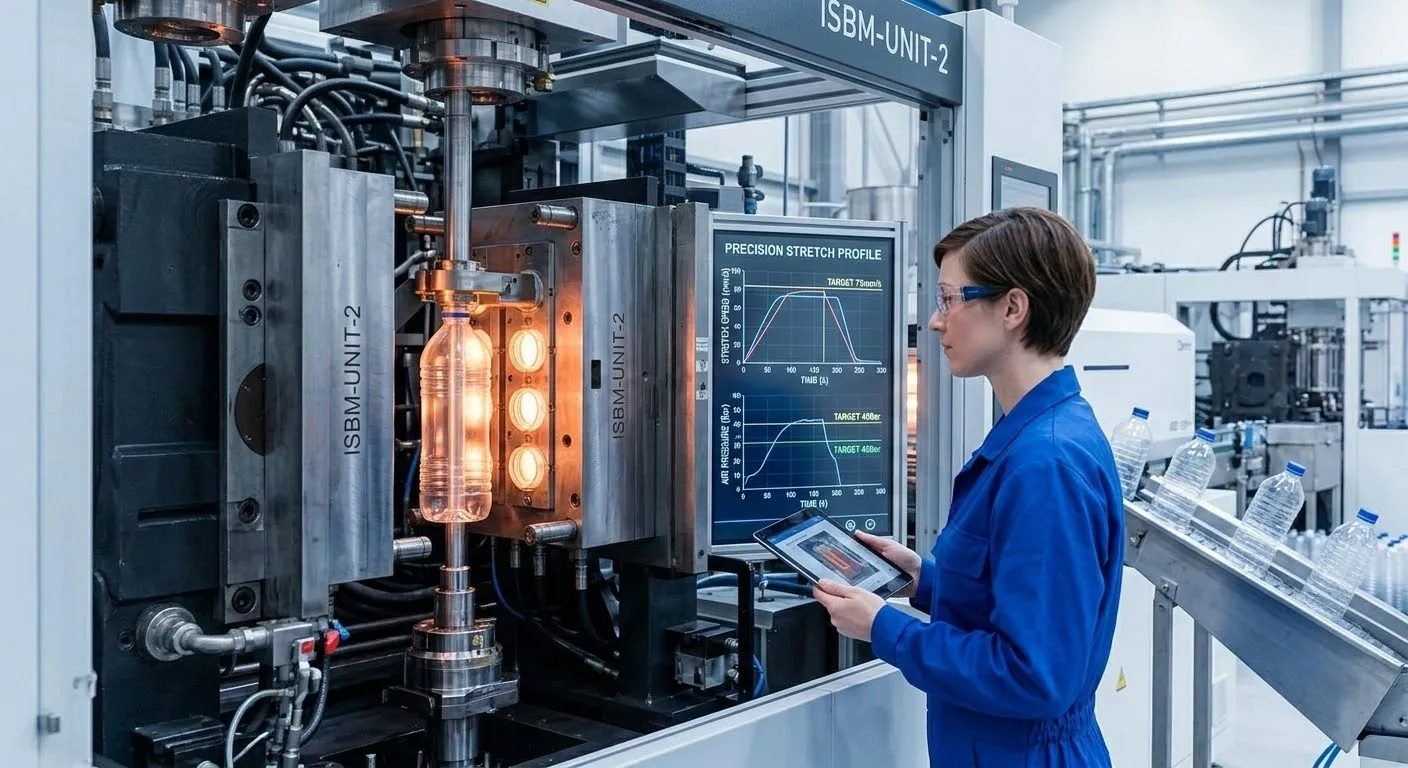
A factory visit to the manufacturer’s production facility is an essential step in supplier evaluation — confirming production capacity, quality control systems, and the machines actually in production.
Step 3: Match the Machine Range to Your Specific Requirement
The best manufacturer for your operation is one whose product range covers your specific container volume, resin, cavity count, and output requirement without compromise. A manufacturer whose largest machine is too small for your container, or whose smallest machine is a poor fit for your format, will supply you with a compromise. Confirm that the supplier has a model with:
- Sufficient injection clamping force for your preform weight and cavity count
- A blow station capacity (mould platen size and blow air volume) that accommodates your bottle’s external dimensions
- A conditioning station (4-station machine) if your bottle has a complex shape requiring precise preform temperature profiling
- A drive system (servo-hydraulic or full-servo) appropriate for your energy cost environment and application (full-servo for pharmaceutical cleanroom; servo-hydraulic for food and beverage)
Step 4: Assess Mould Supply Capability
The best ISBM machine manufacturers also supply matched mould sets: preform mould, blow mould, and stretch rod designed and tested on the specific machine being purchased. Ordering machine and mould from the same supplier eliminates the most common source of commissioning problems — dimensional incompatibility between the mould set and the machine’s mandrel geometry, platen size, and cooling connections. It also provides a single point of accountability when quality issues arise after installation: there is no disagreement between machine supplier and mould supplier about whose component is responsible for a bottle defect.
When evaluating mould capability, ask to see: examples of mould drawings and preform designs for applications similar to yours; the mould manufacturer’s CNC and EDM equipment list; and the mould qualification protocol (what first-article tests are performed before a mould is shipped). Suppliers who outsource all mould manufacture to unrelated third parties without a formal qualification process represent higher risk than those who manufacture or closely manage their own tooling.
Step 5: Verify After-Sales Support in Your Market
After-sales support is the most financially significant variable that does not appear in a machine price comparison. An ISBM machine that stops running for three days because a critical spare part is on a six-week shipping delay costs significantly more in lost production than any price difference between suppliers. The support questions to ask are specific and non-negotiable:
- Spare parts lead time: what is the shipping time for your three most commonly replaced wear items (stretch rod seal, blow valve, gate tip) to my country?
- Remote diagnostics: can your engineers access my machine’s HMI remotely to diagnose faults without travel?
- On-site response: who is your nearest authorised service engineer to my facility, and what is their guaranteed response time?
- Reference customers: can you provide contact details for two installed customers in my industry in my region who I can call directly?
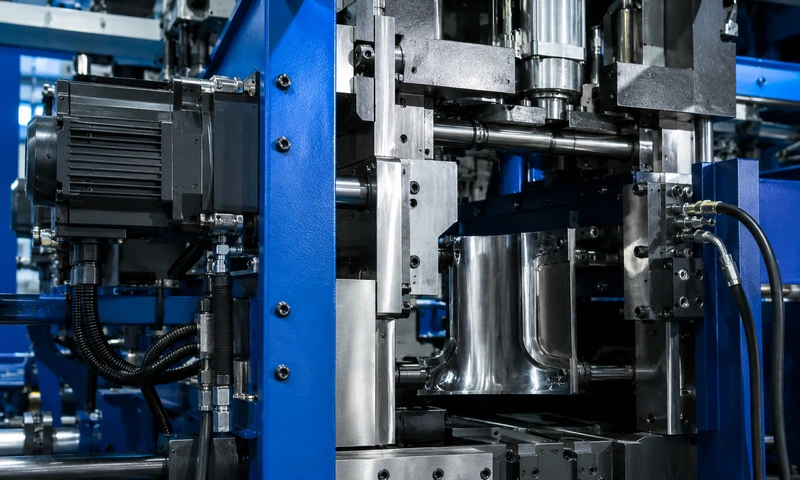
Servo-hydraulic drive system on the EP-HGY series — on-demand pump operation reduces energy consumption by up to 45% and is a key technical differentiator to evaluate across suppliers.
Step 6: Conduct a Factory Visit and Machine Demonstration
No supplier evaluation is complete without a factory visit. The factory visit should include: observation of the supplier’s production floor to confirm actual manufacturing capacity and quality control systems; a live machine demonstration running a bottle similar to your target container, with cycle time data logged from the HMI; bottle weight variation data from a 30–60 minute production run; and energy consumption measurement in kWh per 1,000 bottles. Request that the demonstration machine be the specific model you are considering purchasing, not a different model from the same range.
If a factory visit is not practical before the purchase decision, request a detailed video of the machine running at rated output with on-screen HMI data visible, and a set of first-article bottle samples from the demonstration run for independent quality verification. These are not substitutes for an in-person visit for large capital purchases, but they provide meaningful evidence of machine performance when travel is not immediately possible.
Step 7: Compare Total Cost of Ownership, Not Purchase Price
Purchase price is the most visible variable in a supplier comparison but typically the least important over a 10-year machine life. The total cost of ownership comparison should include: machine purchase price; mould set cost; ancillary equipment (compressor, chiller, dryer); energy cost over 10 years at your local electricity rate and the machine’s rated consumption; scheduled maintenance cost including spare parts; and estimated downtime cost based on the supplier’s support response capability in your market. A machine that costs 15% less to buy but 40% more to run will typically cost USD 30,000–80,000 more over 10 years than the more efficient alternative. Making this calculation explicit before the purchase decision is the discipline that separates strategic capital procurement from price-driven purchasing.
| Evaluation Criterion | What to Ask / Check | Weight |
|---|---|---|
| Process specialisation | % revenue from ISBM; installed base size | بالا |
| Machine range fit | Does a specific model match your clamp, volume, cavity count? | بالا |
| Mould supply | In-house or managed tooling; FAT protocol | بالا |
| After-sales support | Parts lead time; remote diagnostics; on-site response | بالا |
| Factory demonstration | Live run; HMI data; bottle samples | Medium |
| کل هزینه مالکیت | 10-year energy + maintenance vs purchase price | بالا |
Ready to evaluate Ever-Power as your ISBM machine supplier?
Ever-Power is a specialist one-step ISBM machine manufacturer supplying pharmaceutical, cosmetic, food, beverage, and industrial packaging producers across Brazil, South Korea, Australia, the Netherlands, the UK, and Canada. We can provide factory demonstration, reference customers, and a total cost of ownership analysis for your specific container.
مرور کنید طیف کامل ماشین آلات EP-HGY و EP-BPETیا کاوش کنید گزینههای قالب سفارشی برای قالب کانتینر شما.
سوالات متداول
How many ISBM machine suppliers should I evaluate before deciding?
For a capital purchase of this size, evaluating three to five suppliers provides enough comparison to make a well-informed decision without consuming excessive procurement time. The evaluation should include at least one specialist ISBM manufacturer, one general plastics machinery company with an ISBM line, and one alternative on price. The comparison should be structured against the criteria above — specialisation, machine fit, mould supply, support, and total cost of ownership — not price alone.
Is it safe to buy an ISBM machine without visiting the factory?
For a first machine from a new supplier, a factory visit is strongly recommended. For repeat purchases from an established supplier with whom you have an existing installation, a factory visit is less critical but still valuable for verifying that a new model meets your expectations before commitment. Remote video demonstration and first-article bottle samples are partial substitutes when travel is not immediately practical, but they do not provide the same level of confidence as an in-person visit.
Should I choose a local or international ISBM machine supplier?
Machine origin matters less than after-sales support quality in your specific market. An international supplier with established spare parts distribution and trained service engineers in your country is more valuable than a local supplier without ISBM-specific process expertise. Confirm the supplier’s actual support infrastructure in your country — not just their marketing claims — before making a decision based on geography.